Open Nav

Industrial control boards are becoming smaller, faster, and more integrated. As factories adopt smarter automation, tighter enclosures, and higher-performance electronics, printed circuit board assemblies must deliver more functionality in less space. In China, this shift is reshaping surface-mount technology assembly practices across the Industrial Electronics supply chain.
Miniaturization is not only a product design trend. It is also a manufacturing challenge. Smaller boards, finer components, and higher layer counts require stronger process control, better design-for-manufacturability collaboration, and more capable SMT lines. For original equipment manufacturers and Electronics Manufacturing service providers, the ability to produce reliable miniature industrial control boards is becoming a key competitive advantage.
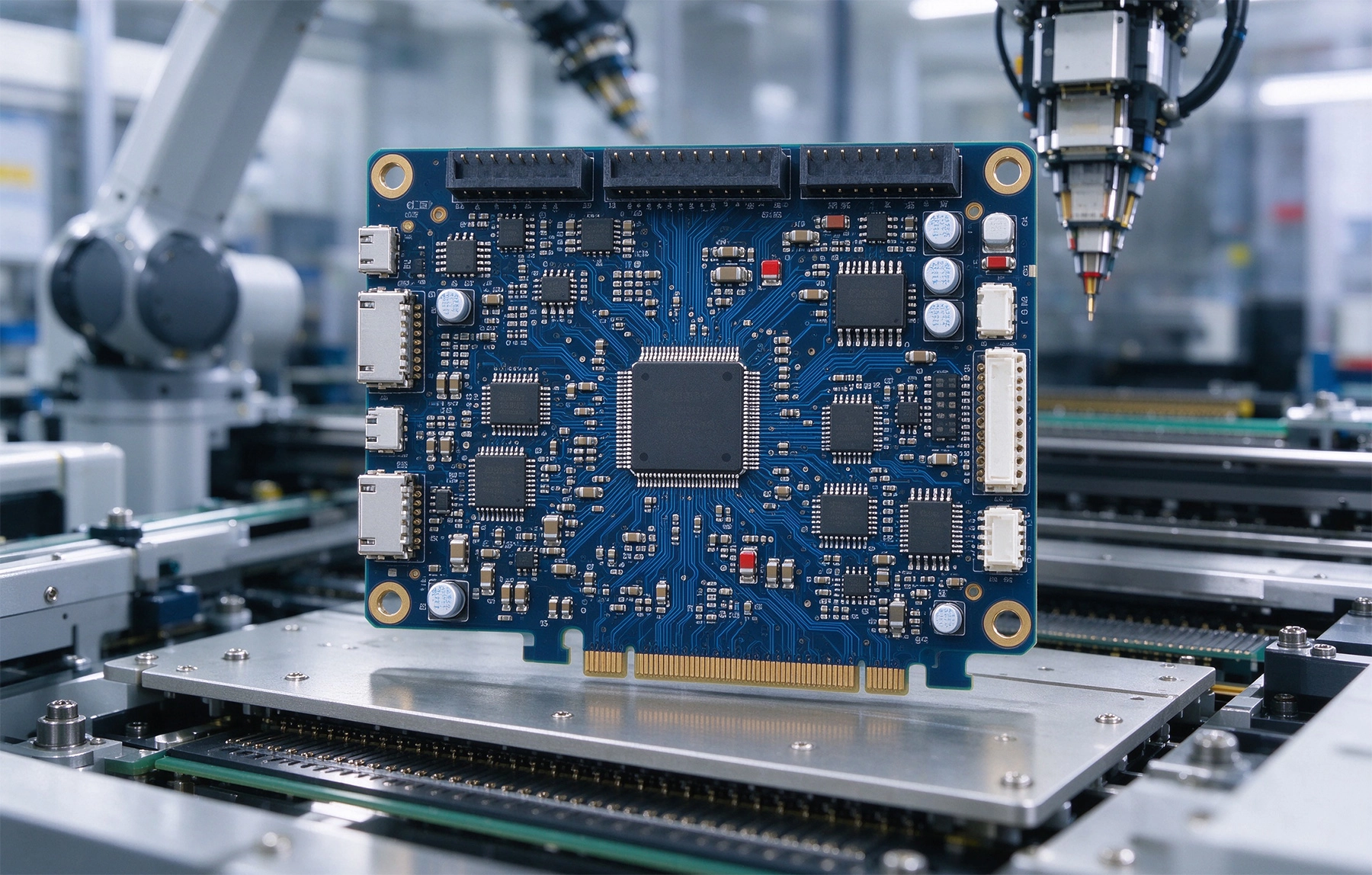
Industrial control systems include programmable logic controllers, motion controllers, servo drives, human-machine interfaces, industrial communication modules, power management units, and sensor interface boards. These systems traditionally prioritized ruggedness, serviceability, and long-term availability over size.
Today, several factors are driving Miniaturization:
These trends are pushing industrial control boards closer to the design complexity seen in Consumer Electronics, while still requiring industrial-grade reliability.
China remains one of the world's largest Electronics Manufacturing bases. Its Smt Assembly sector supports a wide range of customers, from domestic Industrial Automation brands to global equipment suppliers. The sector has matured from low-cost assembly toward higher-value manufacturing that includes advanced Component Placement, mixed-technology assembly, testing, and system integration.
Miniaturization is accelerating this transition. Customers no longer ask only whether a factory can assemble a board. They also ask whether it can handle fine-pitch devices, ultra-small passives, complex ball grid arrays, Controlled Impedance structures, and high-mix production with stable quality.
Leading SMT suppliers in China are responding by upgrading equipment, improving process engineering, and strengthening collaboration with design teams. The gap between prototype capability and mass-production capability is narrowing, especially in regions with mature electronics supply chains.
The use of 0402, 0201, and even smaller passive components is increasing in industrial control boards. These components save board space and support higher circuit density. However, they also require precise Solder Paste Printing, accurate placement, and optimized reflow profiles.
For SMT lines, handling miniature passives means tighter control of stencil design, solder paste volume, nozzle selection, feeder accuracy, and inspection systems. Missing or tombstoned components become more likely if process windows are not well managed.
Industrial controllers increasingly use fine-pitch QFNs, BGAs, and other advanced packages. These devices offer better performance and smaller footprints but demand accurate solder paste deposition, controlled reflow, and reliable inspection.
X-ray Inspection has become more important for verifying BGA solder joints, voiding, and alignment. Optical inspection alone is often insufficient for hidden joints or complex package structures.
High-density Interconnect boards are no longer limited to Consumer Electronics. Some industrial control modules now use HDI features such as microvias, blind vias, buried vias, and via-in-pad structures to route dense digital interfaces, high-speed communication lines, and compact power management circuits.
HDI adoption in industrial applications is usually selective. Control, communication, and sensing sections may benefit most from HDI, while high-voltage or high-current sections may still use conventional multilayer boards. This creates additional requirements for lamination, via reliability, and Thermal Management.
Industrial control boards often combine surface-mount devices, through-hole connectors, Power Components, transformers, and heavy mechanical parts. Miniaturization makes mixed-technology assembly more complex because small components must coexist with larger, heavier parts on the same board.
SMT suppliers are using selective soldering, pin-in-paste processes, and optimized fixture design to handle these mixed requirements. The goal is to reduce manual soldering while maintaining joint reliability and mechanical strength.
Modern industrial controllers support Ethernet, fieldbus protocols, wireless modules, isolated interfaces, and multiple sensor inputs. These functions increase component density around processors, isolators, transceivers, and connectors.
Miniaturization therefore depends not only on smaller components but also on better partitioning. Power, analog, digital, communication, and safety circuits must be arranged to avoid noise coupling while still fitting into a compact layout.
Solder Paste Printing remains one of the most critical steps in Smt Assembly. As components become smaller and pitches become finer, even small variations in paste volume can cause defects such as bridging, insufficient solder, or component misalignment.
Advanced SMT lines are using finer stencil apertures, nano-coated stencils, solder paste inspection systems, and closed-loop process control to improve consistency. Paste storage, handling, and printing speed also require stricter management.
Miniature components and fine-pitch devices require higher placement accuracy. Pick-and-place machines must maintain precision over long production runs and frequent changeovers. Feeder calibration, nozzle condition, and component tape quality all affect yield.
High-mix industrial production adds another layer of complexity. Frequent product changes increase the risk of feeder setup errors, component misidentification, and program mismatches.
Smaller components heat up faster than larger ones, while heavy connectors and ground planes heat up more slowly. This thermal imbalance can create soldering defects if the Reflow Profile is not optimized.
For mixed-technology industrial boards, profile development must consider component sensitivity, solder paste type, board thickness, copper distribution, and fixture design. Thermal profiling is increasingly treated as a standard process step rather than an occasional check.
Miniaturization reduces the margin for visual inspection. Automated Optical Inspection and X-ray Inspection are becoming essential for high-density industrial assemblies. Aoi helps detect missing components, misalignment, solder bridging, and polarity errors, while X-ray inspection supports BGA and hidden joint verification.
In-circuit testing and functional testing are also gaining importance. As boards become denser, debugging failures after full assembly becomes more expensive. Early test coverage helps identify process issues before they affect large batches.
Miniaturization exposes weak design-for-manufacturability practices. Layouts that work in simulation may be difficult to assemble if component spacing, Fiducial Marks, thermal relief, or solder thief pads are not properly designed.
Chinese SMT suppliers that offer early Dfm feedback can reduce defects and shorten development cycles. Collaboration between design engineers and manufacturing engineers is becoming more important than simply transferring Gerber Files to production.
Industrial control boards must operate in harsh environments. They may face temperature cycling, vibration, humidity, electrical noise, and long service life expectations. Miniaturization cannot come at the expense of reliability.
Key reliability concerns include:
Quality management systems, Traceability, and process documentation are especially important for industrial customers. Many buyers require lot tracking, First Article Inspection reports, process audit records, and failure analysis support.
Many SMT factories are investing in high-precision printers, advanced pick-and-place machines, 3D solder paste inspection, 3D Aoi, X-ray inspection, and selective soldering systems. These upgrades support finer components and more complex assemblies.
Equipment alone is not enough. Stable miniaturized assembly depends on process engineering. Suppliers are strengthening capabilities in solder paste management, reflow profiling, Dfm review, failure analysis, and new product introduction.
Industrial customers increasingly require production Traceability. SMT suppliers are adopting manufacturing execution systems, barcode tracking, component lot management, and real-time process monitoring. Digital records help identify root causes when defects occur and support customer audits.
Miniaturized industrial boards often use specialized components with longer lead times or limited availability. SMT suppliers that can coordinate component sourcing, substitution review, and inventory management add significant value.
This is particularly important for industrial products with long life cycles. Component Obsolescence management becomes part of manufacturing strategy rather than an afterthought.
When sourcing miniature industrial control board assembly from China, OEMs should evaluate more than unit price. Important selection criteria include:
A capable SMT partner should act as an extension of the product development team, not only as a production vendor.
Miniaturization is reshaping industrial control board manufacturing in China. Smaller components, higher integration, and denser layouts are pushing SMT assembly toward greater precision, stronger process control, and closer collaboration between design and manufacturing teams.
For Industrial Electronics brands, the benefit is clear: more functionality in smaller systems with improved performance. For SMT suppliers, the challenge is equally clear: miniaturization demands higher capability across equipment, engineering, quality management, and supply chain coordination.
The next phase of growth in China's SMT assembly sector will likely belong to manufacturers that can balance density with reliability. In industrial control applications, small size matters, but long-term stability, test coverage, and manufacturability matter even more.
They are shrinking due to space constraints, higher integration, smarter automation requirements, and the availability of smaller, more powerful components.
HDI use is growing but remains selective. It is most common in control, communication, and sensing sections where routing density is high, while high-voltage or high-current areas may still use conventional PCBs.
The main challenges include solder paste printing control, fine-pitch placement accuracy, Reflow Profile optimization, inspection coverage, and maintaining reliability in harsh industrial environments.
OEMs should request DFM reviews, require SPI/AOI/X-ray inspection, confirm traceability systems, validate first articles, and choose suppliers with proven experience in industrial electronics rather than only consumer products.
Why Medical Device Manufacturers Choose China for SMT PCB Assembly ApplicationsJuly/21/2026

SMT PCB Assembly China Applications for Smart Home and Wearable DevicesSeptember/16/2026
Cost Comparison: SMT vs THT PCB Assembly Services in ChinaJuly/07/2026

Optimizing Component Spacing and Land Patterns for Flawless SMT Assembly in ChinaSeptember/18/2026
High-Reliability SMT PCB Assembly China Applications in the Automotive IndustryJuly/10/2026
PCB Stack-up Considerations for Reliable SMT PCB Assembly in Chinese Supply ChainsSeptember/20/2026
How China's SMT PCB Assembly Process Meets International IPC-A-610 StandardsJuly/22/2026
Communicating DFM Rules Effectively with Your SMT PCB Assembly China PartnerAugust/03/2026