Open Nav

In 2026, quick-turn Smt Assembly in China is no longer defined only by how fast a placement machine can run. The real bottleneck has shifted upstream: can the factory confirm the Bom, locate components, verify stock accuracy, prepare feeders, and release the job to the line without days of manual coordination? The answer increasingly depends on digital inventory. When inventory data is connected to ordering, engineering, warehouse, and MES systems, Quick-turn Smt becomes a predictable workflow rather than a series of emergency phone calls. This is why How Digital Inventory Enables Fast Quick-turn Smt Assembly in Chinese Factories has become a central topic for hardware teams sourcing prototypes, Npi builds, and small-batch production from China.
Chinese SMT factories have long benefited from dense electronics supply chains, especially in the Pearl River Delta. But proximity to suppliers alone cannot guarantee 24–48 hour turnaround. Quick-turn assembly requires real-time visibility into component availability, accurate reel counts, controlled MSD and solder paste handling, fast kitting, and automatic error prevention at the feeder. Digital inventory systems make this possible by turning warehouse data into production-ready signals.
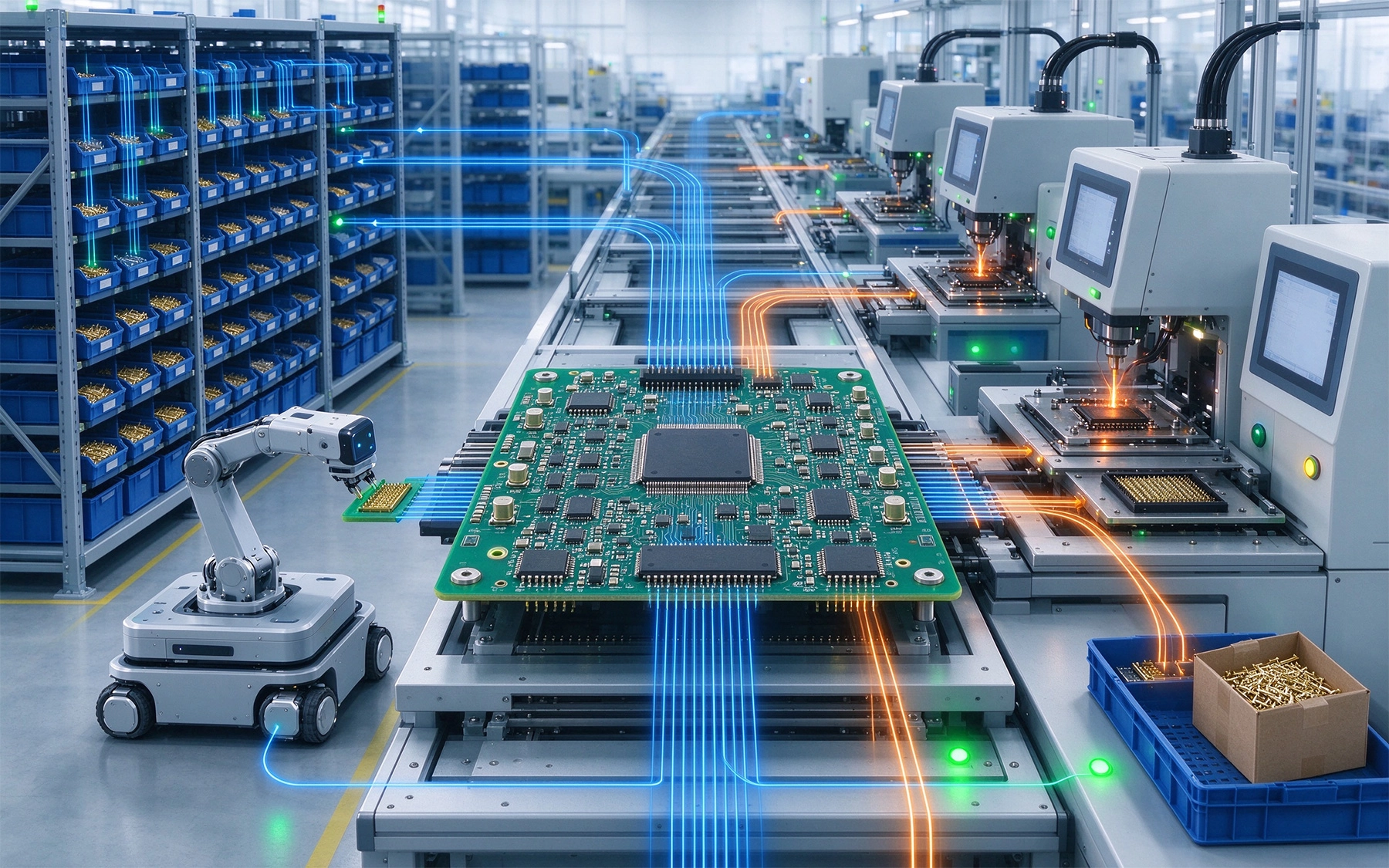
Traditional SMT warehouses often rely on Excel records, paper tags, and manual stock checks. This works for stable mass production, but it breaks down under quick-turn pressure. Common failure points include:
In quick-turn environments, even one missing reel can stop an entire line. Digital inventory prevents these delays by making material readiness visible before the board reaches the shop floor.
When a customer uploads a BOM, a digital inventory system can match part numbers, packages, and manufacturers against live stock records. This allows factories to classify components as in-stock, purchasable, customer-supplied, or at risk. For quick-turn orders, this step replaces days of manual email confirmation with minutes of automated screening. Some Chinese PCBA platforms have pushed this further by integrating PCB Fabrication, component libraries, and SMT scheduling into one flow, so engineers can see assembly feasibility almost immediately after upload.
Quick-turn assembly depends on reel-level accuracy, not just warehouse-level totals. X-ray counting, barcode scanning, and smart shelving help confirm how many components remain on each reel. This prevents situations where the system shows 500 pieces available but the physical reel contains only 30. When inventory data is synchronized with MES and WMS, the factory can reserve exact quantities for urgent jobs and avoid double allocation.
Pick-by-light systems, electronic shelf labels, and WMS-directed picking allow warehouse staff to prepare kits quickly and correctly. For Quick-turn Smt, the goal is to move from “order released” to “feeders loaded” with minimal manual interpretation. Digital systems can generate pick lists based on feeder slots, reel sizes, and moisture-handling requirements, reducing both preparation time and the risk of wrong components reaching the line.
Digital inventory does not end at the warehouse door. Modern SMT lines track material consumption, reel changes, tail counts, and feeder assignments in real time. If a reel runs low, the system can trigger replenishment before the machine stops. For high-mix quick-turn production, this visibility is critical because lines change over frequently and cannot afford repeated material starvation.
Quick-turn orders carry higher human-error risk because preparation time is compressed. Digital inventory reduces this risk through barcode verification, feeder-program binding, and first-article inspection integration. When the scanned reel does not match the BOM or feeder plan, the system can block loading or alert operators before solder paste is printed. This is especially valuable for small components such as 0201, 01005, QFN, and BGA packages, where visual identification is unreliable.
Fast assembly must not compromise material integrity. Moisture-sensitive devices require controlled storage, bake records, and exposure-time tracking. Solder paste requires refrigeration, warm-up, stirring, and usage-window management. Digital inventory systems can automatically record when a component bag is opened, how long it has been exposed, and whether it must be baked before mounting. Without this control, a quick-turn build may pass initial assembly but fail later due to hidden moisture damage or expired paste.
The strongest quick-turn capabilities appear when inventory data is not isolated. ERP manages purchasing and cost, WMS manages storage and picking, and MES manages production execution. When these systems share the same digital inventory layer, the factory can:
This integration is one reason why some Chinese SMT providers can offer 12–48 hour quick-turn services for prototypes and small batches. Their speed comes less from heroic overtime and more from eliminating waiting time between departments.
Many fast-turn Chinese factories now maintain large private component libraries covering common resistors, capacitors, connectors, power devices, and mainstream ICs. When these libraries are digitized, the factory can match customer BOMs against available stock and propose substitutions with the same package and electrical characteristics. This model is particularly effective for research prototypes, IoT devices, industrial controllers, and early-stage hardware startups that need fast iteration rather than lowest-cost mass procurement.
Digital inventory is powerful, but it is not a substitute for supply-chain depth. Rare components, long-lead ICs, export-controlled parts, and counterfeit risks cannot be solved by software alone. Quick-turn assembly also requires disciplined engineering data: accurate footprints, clear MPNs, approved alternates, and realistic panelization. The best results occur when customers provide clean BOMs and factories maintain accurate, audited digital stock records.
Quick-turn Smt Assembly in Chinese factories is evolving from a manual coordination challenge into a data-driven production workflow. Digital inventory removes the hidden delays that traditionally slow down prototyping: uncertain stock, slow BOM checks, incorrect picking, feeder mismatches, and uncontrolled material shelf life. When connected with MES, WMS, and ERP systems, it gives factories the ability to promise shorter lead times with higher confidence. For global hardware teams, understanding How Digital Inventory Enables Fast Quick-turn Smt Assembly in Chinese Factories is essential for selecting partners that can deliver not just fast quotes, but fast, reliable, and traceable PCBA builds.
For standard prototypes with available components, many Chinese quick-turn providers can complete SMT assembly within 24–48 hours after engineering confirmation. The actual speed depends on BOM completeness, component availability, and order queue.
No. It improves visibility and reduces preparation time, but it cannot create stock for obsolete or long-lead parts. Its main value is preventing false availability and accelerating kitting, substitution review, and feeder preparation.
No. Small and medium SMT factories also benefit from barcode scanning, WMS-directed picking, X-ray counting, and MES-linked material tracking. The scale of implementation may differ, but the principle is the same: accurate, real-time inventory data reduces quick-turn delays.
How to Get Quick-turn SMT PCB Assembly in Just 24 Hours from ChinaJune/12/2026
Balancing Speed and Quality in Quick-turn SMT PCB Assembly China ServicesJuly/30/2026
Balancing Speed and Quality in Quick-turn SMT PCB Assembly China ServicesJuly/20/2026
What to Prepare for a Smooth Quick-turn SMT Assembly Order in ChinaAugust/10/2026

How to Get Quick-turn SMT PCB Assembly in Just 24 Hours from ChinaMay/29/2026
The Benefits of Quick-turn SMT Assembly in China for R&D and PrototypingJuly/09/2026

Why Shenzhen is the Global Hub for Quick-turn SMT PCB AssemblySeptember/04/2026
Quick-turn SMT Assembly in China: Accelerating Your Time-to-MarketSeptember/15/2026