
Design For Manufacturability represents the bridge between engineering intent and manufacturing reality. When design teams and assembly partners share clear understanding of Dfm requirements, production proceeds smoothly with minimal surprises, rework, or delays. When communication breaks down, the consequences manifest as extended development cycles, increased costs, and strained relationships that undermine the collaborative partnerships both parties seek. For companies working with China-based Smt Assembly partners, cultural differences, time zone separation, and communication channel limitations create additional challenges that require deliberate communication strategies.

When design rules and manufacturing capabilities are not clearly communicated, both parties bear the costs. Engineering teams receive boards that do not match their intent, requiring redesign iterations that extend timelines. Assembly partners produce assemblies that fail inspection, incurring rework costs and schedule pressure. Customers waiting for products experience delays that damage brand reputation and competitive position. The cascade of consequences from poor Dfm communication demonstrates why investing in communication infrastructure pays dividends for all stakeholders.
Beyond direct costs, poor communication damages relationships that take time to rebuild. Assembly partners become reluctant to take on challenging designs when previous projects required extensive troubleshooting. Design teams become frustrated when manufacturing outcomes do not match expectations. This relationship erosion limits future collaboration opportunities and makes it harder to achieve the strategic partnerships that benefit both parties.
Complete design file packages form the foundation of effective DFM communication. These packages should include Gerber files for each copper layer, solder mask, and silkscreen layer. Drill files in Excellon format, both plated and non-plated as applicable. Assembly drawings with component callouts, orientation indicators, and special instructions. Bill of materials with manufacturer part numbers, alternates where approved, and any special handling notes.
File naming conventions should be consistent and descriptive. Avoid generic names like "gerber_v3" that provide no information about content. Use structured naming like "PROJECT_BOARD_L1_COPPER_REV2.GER" that identifies the board, layer, and revision. This practice prevents version confusion and helps assembly partners quickly locate the correct files when questions arise.
Layer stackup documentation ensures that the fabricated board matches the design intent for impedance control, Signal Integrity, and mechanical requirements. Provide stackup drawings that identify each layer including core thickness, prepreg thickness, and copper weight. Specify material types with manufacturer and grade designations. Note any impedance-controlled layers with target values and tolerance requirements.
Material specifications extend beyond basic stackup to include surface finish requirements, solder mask type, and any special requirements like Controlled Impedance or high-frequency materials. Ambiguities in material specifications create opportunities for misinterpretation. When designs require specific materials that may not be standard inventory items, explicit communication prevents surprise when lead times extend unexpectedly.
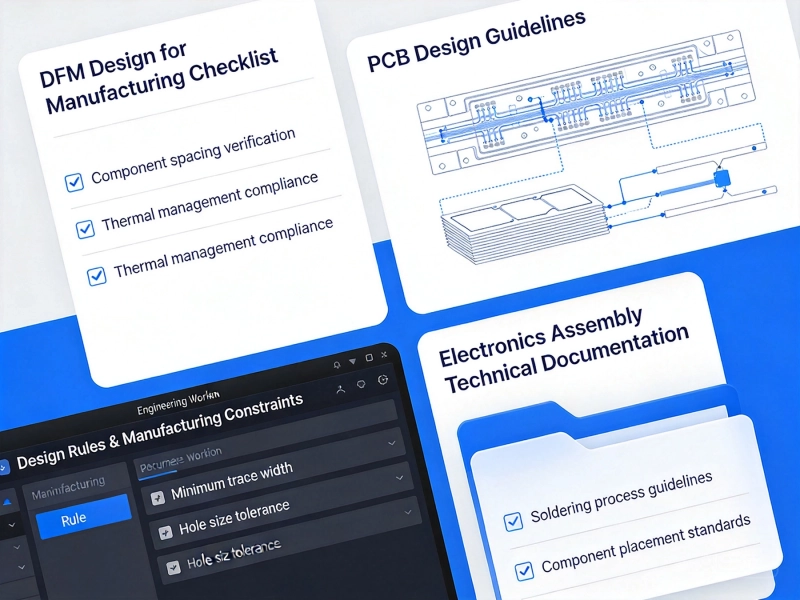
Design rule specifications communicate the dimensional constraints that designs must meet. These rules define minimum trace widths, spacing requirements, annular ring dimensions, and via specifications. Providing these rules in writing prevents disputes about whether the design or the fabrication created any issues that emerge during production.
When designs push manufacturing limits, explicit notation flags these areas for special attention. Notes like "Critical impedance trace - verify on production panels" or "Fine-pitch BGA - request enhanced inspection" alert assembly partners to areas requiring extra process control. This proactive communication prevents problems from escaping detection until they cause field failures.
Regular communication cadences maintain alignment throughout project execution. Weekly updates during new product introduction keep both parties informed of progress and issues. Monthly reviews during ongoing production identify trends and improvement opportunities. Quarterly business reviews assess relationship health and strategic alignment. Each cadence serves different purposes and involves different levels of the organization.
The frequency and format of touchpoints should match the project phase and risk level. Early-stage projects with many unknowns benefit from more frequent communication. Mature products with stable processes can operate with less frequent check-ins. When problems emerge, ad-hoc communications should supplement regular cadences until issues resolve.
Asynchronous communication tools like email and project management platforms work well for routine updates and documentation sharing. These tools create searchable archives that preserve institutional knowledge across team changes. However, asynchronous communication can slow issue resolution when quick back-and-forth would more efficiently resolve questions.
Synchronous communication through video conferencing, instant messaging, or phone calls provides faster resolution for complex issues. Scheduling regular video calls with your China partner accounts for the time zone difference and enables real-time collaboration on challenging problems. The best approach combines both methods, using asynchronous tools for routine communication and synchronous tools when issues require immediate resolution.
Clear escalation procedures ensure that issues reach the right people quickly. Define criteria for when issues should escalate beyond the day-to-day team. Identify escalation paths that involve engineering, quality, and management as appropriate. Communicate escalation procedures to all team members so that problems receive appropriate attention without unnecessary delays.
Escalation should feel safe rather than punitive. Teams that view escalation as failure rather than problem-solving hinder their own resolution efficiency. When escalation occurs, focus on problem resolution rather than assigning blame. Follow-up on escalated issues to confirm resolution and identify preventive actions.
Completing DFM reviews before sending designs to manufacturing catches problems early when they cost least to fix. Design teams should review their own designs against manufacturer capability guidelines. Engineering review of manufacturing constraints ensures that designs respect fabrication limits. Quality review verifies that testability and inspection requirements are addressed.
When designs include unconventional features or push capability boundaries, proactive communication before handoff prevents surprise. Share design files with comments explaining unconventional approaches and the rationale behind challenging specifications. This context helps assembly partners prepare appropriate process controls and inspection strategies.
First article inspection provides an opportunity to verify that designs and manufacturing processes align before volume production begins. Coordinate first article schedules to ensure that engineering resources are available to support inspection and disposition. Plan sufficient time for first article evaluation before committing to production schedules.
Document first article findings comprehensively, including both acceptable variations and concerns requiring resolution. Share findings with design teams to inform future design iterations. When first article reveals systematic issues, investigate whether design rules or communication practices need adjustment to prevent recurrence.
Clear revision control prevents confusion about which design version is current. Establish revision naming conventions that all parties understand. Communicate revision changes clearly, highlighting modifications that affect manufacturing or test processes. Maintain revision histories that document the evolution of designs over time.
When engineering changes occur mid-production, communicate changes immediately with clear documentation of what differs from previous revisions. Assembly partners cannot accommodate changes they do not know about. Proactive change communication prevents producing assemblies based on outdated information.
Working effectively with China partners benefits from cultural awareness that enhances communication. Direct communication styles common in Western business contexts may create discomfort or resistance. Taking time to understand communication preferences helps both parties adapt their approaches for more effective collaboration.
Building relationships before transactions creates foundations for more productive collaboration. Face-to-face meetings during relationship establishment, whether in person or virtual, strengthen bonds that text-based communication cannot replicate. These investments in relationship building pay returns through smoother execution and more constructive problem resolution.
Sharing knowledge benefits both parties over time. When design teams understand manufacturing capabilities and constraints, they design more producible products. When manufacturing partners understand design intent and application requirements, they apply appropriate process controls. This mutual education improves collaboration efficiency and design outcomes.
Joint training programs, technical exchanges, and shared learning opportunities accelerate capability development. Some companies invite manufacturing partners to their facilities to understand product applications. Others send design engineers to manufacturing sites to observe production processes. These investments in mutual understanding build partnerships that transcend individual transactions.
Systematic feedback collection identifies improvement opportunities on both sides. Post-project reviews assess what went well and what could improve. Quantitative metrics like first-pass yield, on-time delivery, and quality levels provide objective feedback inputs. Qualitative feedback from team members captures insights that metrics alone cannot convey.
Acting on feedback demonstrates that input is valued and drives Continuous Improvement. When feedback reveals communication gaps, develop new practices that address the root causes. Share improvement outcomes with all stakeholders to encourage continued feedback participation.
Language differences create potential for miscommunication even when both parties use English. Technical terminology may have different meanings in different contexts. Idiosyncratic phrasing may confuse readers expecting standard terminology. Taking extra care with communication precision prevents misunderstandings.
When technical discussions become complex, request confirmation of understanding from the other party. Asking "Can you summarize what you understood from my explanation?" verifies alignment without implying criticism. This practice catches misalignments early before they create execution problems.
Time zone differences between China and Western business centers require deliberate coordination. Identifying overlapping working hours for synchronous communication narrows available windows but enables real-time collaboration. Scheduling meetings during these windows shows respect for the other party's time while enabling more effective communication.
For urgent issues outside overlapping hours, establish protocols for handling situations that cannot wait. Clear definitions of what constitutes urgent versus routine help both parties manage expectations. Knowing when to wake someone versus when to wait for next-day response prevents both under-reaction and alarm fatigue.
When specifications are ambiguous, resist the temptation to assume and proceed. Clarification requests prevent execution against incorrect assumptions. Assembly partners who ask clarifying questions demonstrate professionalism rather than inadequacy. Encourage your teams to welcome rather than discourage clarification requests.
When ambiguity exists in manufacturer capabilities or processes, request visual documentation or examples that clarify requirements. Seeing actual examples of acceptable versus unacceptable products provides more clarity than written descriptions alone. This investment in understanding prevents execution errors.
What is the most important document to share with a new assembly partner?
Complete design files including Gerbers, drill files, BOM, and assembly drawings form the essential starting point. However, the most important document is often a clear statement of your quality requirements and application environment. Understanding how your product will be used helps assembly partners apply appropriate process controls and inspection intensity.
How detailed should DFM specifications be?
Specifications should be complete enough to prevent ambiguity but not so detailed that they become overwhelming. Focus on requirements that are critical to your application and any areas where your design pushes manufacturing limits. Standard manufacturing practices can be assumed without explicit documentation.
How should we handle disagreements about DFM requirements?
Approach disagreements as collaborative problem-solving rather than adversarial negotiation. Both parties share the goal of producing working products efficiently. When disagreements occur, seek to understand the other party's perspective and constraints. Often creative solutions emerge when both parties explain their underlying concerns.
What communication frequency is appropriate for ongoing production?
Ongoing production typically requires less frequent communication than new product introduction. Monthly status updates during stable production keep both parties informed without excessive meeting overhead. Weekly updates are appropriate when production volumes are high or when issues are being resolved.
How do we build trust with a new China assembly partner?
Trust builds through consistent execution over time. Start with smaller orders that allow both parties to learn each other's processes and communication styles. Demonstrate your own reliability in responding to requests and honoring commitments. Address problems constructively when they occur rather than assigning blame.
Effective DFM communication requires deliberate investment in documentation practices, communication channels, and relationship building. The strategies outlined in this article provide a framework for improving collaboration with China Smt Assembly partners. However, every relationship has unique characteristics that require adaptation of general principles to specific circumstances.
Start by assessing your current communication practices against the ideals described here. Identify the highest-impact improvements that would benefit your most critical partnerships. Implement changes incrementally, measuring outcomes to verify that improvements deliver expected benefits. Continuous refinement of communication practices creates cumulative relationship strength over time.
The goal of DFM communication is not perfection but Continuous Improvement. No communication system eliminates all surprises or prevents all problems. When issues emerge, approach resolution constructively, using problems as opportunities to strengthen the partnership. The most resilient business relationships are those that have navigated challenges together and emerged stronger from the experience.
The Role of SMT Assembly in China's Modern Industrial Automation and Robotics SectorAugust/08/2026
Essential DFM Guidelines for SMT PCB Assembly in ChinaMay/29/2026
Essential DFM Guidelines for SMT PCB Assembly in ChinaJune/04/2026

How DFM Analysis in China Can Prevent Costly SMT Assembly DelaysAugust/14/2026
Top 10 DFM Mistakes to Avoid Before Sending Files to China for SMT AssemblyJuly/14/2026

Optimizing Component Spacing and Land Patterns for Flawless SMT Assembly in ChinaSeptember/18/2026
Why DFM is Critical for High-Density BGA SMT Assembly in ChinaJuly/25/2026
How to Reduce SMT PCB Assembly Costs in China with Early DFM AnalysisJune/17/2026