
China has become the world's manufacturing powerhouse for electronics, and SMT PCB Assembly sits at the heart of this remarkable capability. From the sophisticated electronics controlling modern vehicles to the tiny sensors making smart homes possible, Chinese manufacturers are producing an astonishing variety of electronic assemblies. Understanding the diverse applications of SMT PCB Assembly in China reveals both the breadth of Chinese manufacturing capability and the specific requirements driving each industry segment.
This comprehensive guide explores the top applications of Smt Pcb Assembly across major industry segments. We'll examine how automotive, Consumer Electronics, Industrial Automation, IoT, medical devices, telecommunications, and aerospace industries rely on Chinese Smt Assembly capabilities. Whether you're sourcing Electronics Manufacturing or developing new products, understanding these applications helps you leverage China's manufacturing strengths effectively.
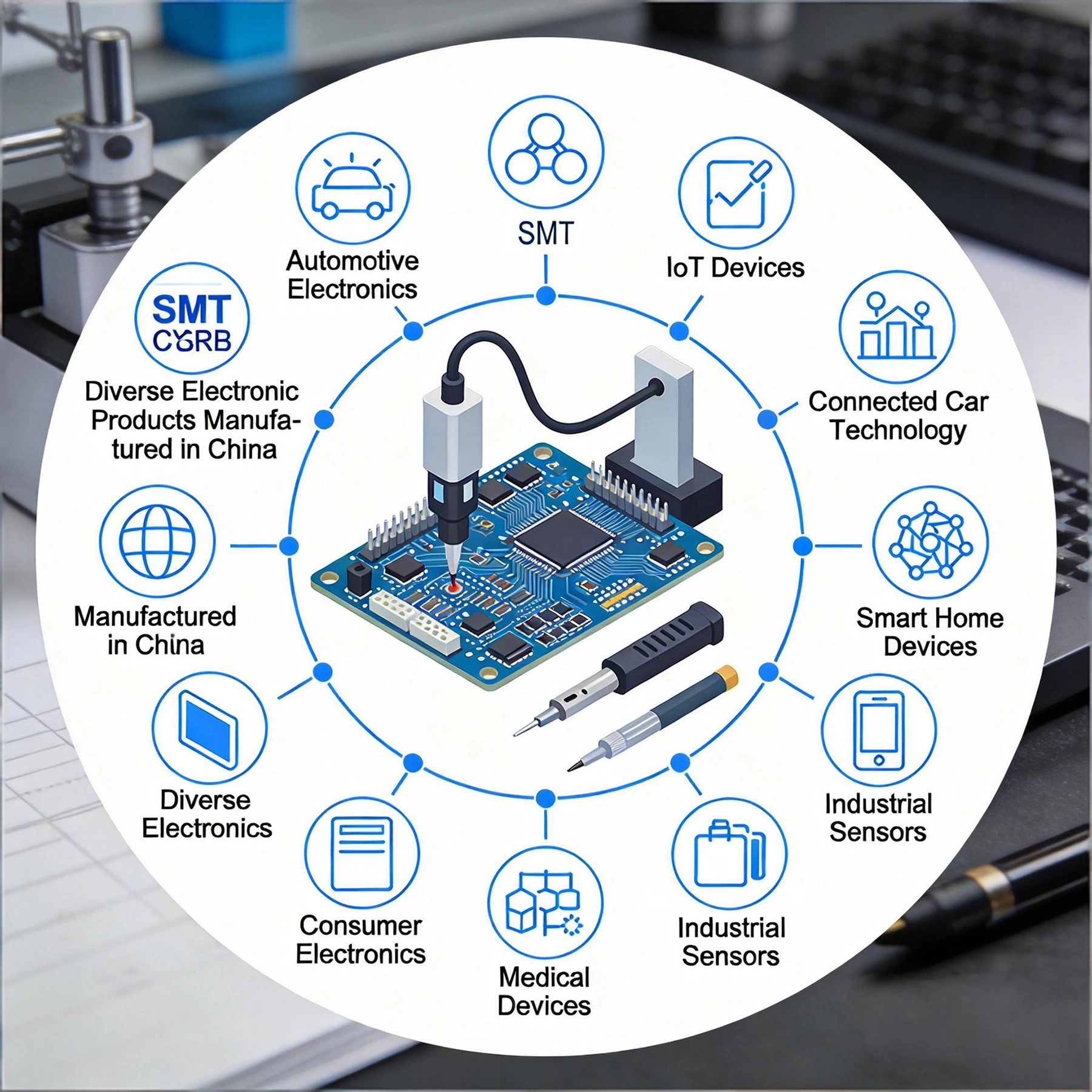
Modern vehicles contain more electronics than ever before. Advanced driver assistance systems, infotainment, engine control, safety systems, and connectivity modules all depend on sophisticated PCB assemblies. Chinese manufacturers have become essential suppliers for Automotive Electronics, meeting the demanding quality and reliability requirements this industry demands.
Automotive Pcb Assembly requirements:
Chinese automotive assembly facilities invest heavily in certifications, process controls, and testing capabilities to meet these demanding requirements. The move toward electric vehicles and autonomous driving only increases the electronics content in vehicles and the importance of reliable automotive assembly.
Advanced Driver Assistance Systems (ADAS):
ADAS technologies including lane departure warning, adaptive cruise control, automatic emergency braking, and parking assist rely on complex sensor arrays and processing units. These systems require high-density PCB assemblies with specialized components like radar modules, camera processors, and sensor fusion electronics.
Electric Vehicle Electronics:
EVs introduce entirely new electronic systems including battery management, motor control, charging infrastructure, and power conversion. These applications demand PCB assemblies capable of handling high currents and managing significant heat generation while maintaining reliability over extended service life.
Infotainment and Connectivity:
Modern vehicle infotainment systems combine entertainment, navigation, vehicle settings, and smartphone integration. These assemblies require both sophisticated processing capabilities and sleek, compact designs that integrate seamlessly into vehicle interiors.
Consumer Electronics represent the highest volume segment of Chinese Smt Assembly. Smartphones, tablets, laptops, wearables, and home entertainment devices flow from Chinese assembly lines in enormous quantities. The scale and efficiency of Chinese consumer Electronics Manufacturing sets global benchmarks.
Consumer electronics characteristics:
Chinese manufacturers have optimized every aspect of consumer Electronics Assembly for this demanding environment. The combination of experienced workforce, sophisticated automation, and efficient supply chains enables production at scales impossible elsewhere.
Smartphones and Tablets:
Mobile devices represent perhaps the most demanding consumer Electronics Assembly challenge. Extreme Miniaturization, sophisticated camera systems, high-speed connectivity, and complex RF assemblies all require cutting-edge SMT capabilities. China's smartphone assembly industry produces billions of devices annually for global brands.
Wearable Technology:
Smartwatches, fitness trackers, and wireless earbuds combine compact size requirements with sophisticated features. These products push the boundaries of miniaturization while demanding attractive industrial design and reliable wireless connectivity.
Home Entertainment:
Smart TVs, streaming devices, gaming consoles, and audio equipment represent significant SMT assembly volume. These products balance performance requirements with consumer-friendly pricing and often require sophisticated Thermal Management solutions.
Factory automation, process control, and industrial sensing systems depend on reliable electronic assemblies operating in demanding environments. Chinese manufacturers serve this critical segment with assemblies designed for durability, precision, and long-term reliability.
Industrial assembly requirements:
Industrial applications often require assemblies to operate reliably for decades, far longer than consumer products. This influences component selection, assembly processes, and quality verification approaches.
Programmable Logic Controllers (PLCs):
PLCs form the backbone of factory automation, controlling machinery and processes throughout manufacturing. These assemblies require sophisticated processing, multiple communication interfaces, and exceptional reliability in industrial environments.
Industrial Sensors and Instrumentation:
Temperature, pressure, flow, and level sensors collect data throughout industrial facilities. These assemblies often operate in harsh environments with exposure to chemicals, temperature extremes, and physical stress.
Human-Machine Interfaces (HMIs):
Industrial touchscreens and control panels provide operator interfaces for complex machinery. These assemblies combine sophisticated display technology with robust industrial-grade construction.
The Internet of Things represents one of the fastest-growing segments of electronics manufacturing. Smart home devices, industrial sensors, wearable health monitors, and countless other connected devices all require compact, efficient, and cost-effective PCB assemblies. Chinese manufacturers lead IoT device production globally.
IoT device characteristics:
Iot Manufacturing challenges include managing enormous product variety while maintaining low costs. Chinese manufacturers have developed flexible production capabilities that accommodate this diversity efficiently.
Smart Home Devices:
Smart speakers, thermostats, security cameras, door locks, and lighting controls represent high-volume IoT categories. These devices combine voice assistants, wireless connectivity, and user-friendly designs in compact enclosures.
Industrial IoT Sensors:
Connected sensors monitoring equipment health, environmental conditions, and process parameters enable predictive maintenance and operational optimization. These assemblies often require industrial-grade reliability in compact packages.
Wearable Health Devices:
Fitness trackers, smartwatches, and medical monitors collect health data and communicate it to smartphones and cloud services. These devices demand miniaturization, low power consumption, and reliable wireless connectivity.
Smart Agriculture:
Connected sensors for soil monitoring, irrigation control, and livestock management support precision agriculture. These devices must operate reliably outdoors with limited power availability.
Medical Electronics require exceptional quality and reliability given their role in patient care. Chinese manufacturers serving this market maintain Iso 13485 quality management systems and rigorous process controls that meet international medical device standards.
Medical assembly requirements:
Medical Device Manufacturing in China has matured significantly, with many facilities achieving certifications recognized by major regulatory bodies worldwide.
Diagnostic Equipment:
Blood glucose meters, blood pressure monitors, pulse oximeters, and other diagnostic devices enable patient monitoring outside clinical settings. These assemblies combine precision analog circuitry with wireless connectivity for data transmission.
Therapeutic Devices:
Insulin pumps, CPAP machines, and hearing aids provide therapeutic functions requiring reliable, long-term operation. These devices often have very stringent size and power consumption requirements.
Medical Imaging:
Portable ultrasound, X-ray detectors, and other imaging devices contain sophisticated signal processing electronics. These assemblies demand both high performance and exceptional reliability.
Telecommunications networks depend on sophisticated electronics from core infrastructure to edge devices. Chinese manufacturers produce vast quantities of telecom equipment ranging from massive base station systems to compact network routers.
Telecom assembly characteristics:
5G network deployment has increased demand for advanced telecommunications assembly capabilities, particularly for millimeter-wave equipment and massive MIMO antenna systems.
Base Station Electronics:
Cellular base stations contain sophisticated RF electronics, signal processing, and power management systems. These assemblies operate in outdoor environments and must maintain reliable operation across extreme temperature ranges.
Network Switching and Routing:
Data center and enterprise networking equipment processes enormous data volumes requiring high-speed PCB assemblies with sophisticated Signal Integrity design. These products push the boundaries of PCB technology.
Fiber Optic Transmission:
Optical network elements convert between electrical and optical signals, requiring precision analog and high-speed digital circuitry. These assemblies demand specialized assembly capabilities for optical components.
Aerospace and defense applications represent the highest reliability segment of electronics manufacturing. Chinese facilities serving this market implement stringent quality systems and specialized processes for assemblies where failure is unacceptable.
Aerospace assembly requirements:
Aerospace and defense assembly often requires specialized materials and processes that differ significantly from commercial electronics manufacturing.
Flight Control Systems:
Avionics assemblies control aircraft systems with absolute reliability requirements. These assemblies undergo extensive testing and qualification before deployment.
Satellite Electronics:
Satellite payloads contain sophisticated electronics operating in the space environment. These assemblies must withstand launch vibration, temperature extremes, and radiation exposure.
Communication Systems:
Military and civilian communication equipment requires secure, reliable electronics operating in challenging environments. These assemblies often have specialized security and encryption requirements.
The electric vehicle revolution creates enormous demand for Power Electronics assemblies. Battery management systems, motor controllers, charging equipment, and power conversion units all require sophisticated PCB assemblies capable of handling high currents and managing significant heat.
EV assembly characteristics:
AI and machine learning applications drive demand for specialized computing hardware including GPU modules, AI accelerators, and neural processing units. These assemblies combine high-density packaging with sophisticated thermal management.
AI hardware characteristics:
AR and VR headsets require compact, lightweight assemblies with high-resolution displays, sophisticated sensors, and powerful processors. Chinese manufacturers lead production of these emerging consumer devices.
AR/VR assembly challenges:
Different regions of China have developed specialized manufacturing capabilities:
Shenzhen and Guangdong Province:
The Pearl River Delta, centered on Shenzhen, represents the world's largest electronics manufacturing cluster. This region specializes in consumer electronics, IoT devices, and rapid prototype production. The concentration of suppliers, talent, and infrastructure creates unparalleled manufacturing ecosystem advantages.
Shanghai and Jiangsu Province:
The Yangtze River Delta around Shanghai hosts sophisticated manufacturing for Automotive Electronics, telecommunications equipment, and Industrial Automation. Higher-end facilities serve demanding applications requiring advanced capabilities.
Beijing and Tianjin Region:
The Bohai Rim region around Beijing and Tianjin focuses on telecommunications, aerospace, and Defense Electronics. Proximity to research institutions and government facilities supports these specialized applications.
Western China:
Manufacturing is expanding into western China, particularly for labor-intensive assembly operations. Chongqing and Chengdu host significant production for products where labor costs are significant.
Different applications require different quality certifications:
Quality management standards:
Process-specific standards:
SMT assembly technology continues advancing:
Emerging capabilities:
Market dynamics continue shifting:
Emerging opportunities:
The applications of Smt Pcb Assembly in China span an extraordinary range of industries and products. From automotive electronics ensuring vehicle safety to IoT sensors enabling smart homes, from medical devices improving patient care to aerospace systems exploring space, Chinese manufacturers deliver the assemblies that make modern technology possible.
Each application area has specific requirements that influence manufacturing approaches. Automotive electronics demand exceptional reliability and zero defect tolerance. Consumer electronics require extreme volume and cost efficiency. Industrial applications need durability in harsh environments. Medical devices require regulatory compliance and complete traceability. Understanding these requirements helps product developers and sourcing professionals work effectively with Chinese manufacturing partners.
Chinese SMT assembly capabilities continue evolving to meet increasingly demanding applications. Advanced packaging technologies, sophisticated quality systems, and specialized processes enable production of assemblies that would have been impossible a decade ago. As new applications emerge and existing applications advance, Chinese manufacturers will continue developing capabilities to serve these markets.
For anyone sourcing electronics manufacturing or developing new products, China's SMT assembly industry offers capabilities unmatched anywhere else in the world. The combination of scale, expertise, infrastructure, and supply chain integration creates manufacturing opportunities unavailable elsewhere. Whether your application is automotive safety systems or IoT sensors, medical diagnostics or telecommunications infrastructure, Chinese SMT assembly capabilities can deliver the manufacturing solution your product requires.
Q: What certifications should I look for in a Chinese SMT assembly partner?
A: Certifications depend on your application. ISO 9001 is baseline for all quality-focused facilities. Automotive applications need IATF 16949. Medical devices require ISO 13485. Aerospace applications need AS9100. IPC certifications (J-std-001, Ipc-a-610) are valuable across all applications. Match certifications to your specific requirements.
Q: How do I select the right manufacturing region in China for my product?
A: Different regions specialize in different applications. Shenzhen area excels at consumer electronics and IoT. Shanghai region handles sophisticated automotive and telecom work. Research your specific application and identify regions with relevant expertise. Consider proximity to component suppliers, logistics infrastructure, and your ability to visit facilities.
Q: What's the typical minimum order quantity for Chinese SMT assembly?
A: Minimum order quantities vary widely. Prototype runs might accept 5-50 units. Standard production typically starts at 100-500 units. High-volume consumer electronics run in thousands or millions. Some facilities accommodate very low quantities for specialized applications. Discuss your volume requirements with potential partners.
Q: How do I ensure quality when sourcing from China?
A: Quality Assurance requires multiple approaches: verify certifications, conduct facility audits, implement incoming inspection, require detailed quality reporting, establish clear specifications, and maintain open communication. First Article Inspection before full production helps catch issues early. Choose partners with documented quality processes and relevant experience.
Q: What are the trends shaping Chinese SMT assembly?
A: Key trends include advanced packaging adoption (chiplets, 2.5D/3D integration), increased automation, smart factory initiatives using AI and data analytics, sustainability requirements, and continued specialization by application area. Reshoring pressures exist but China maintains significant advantages in cost, capability, and supply chain integration.
Top Applications of SMT PCB Assembly in China: From Automotive to IoTJune/15/2026
High-Reliability SMT PCB Assembly China Applications in the Automotive IndustryJuly/10/2026
Understanding Reflow Soldering Profiles Used in SMT PCB Assembly ChinaJune/30/2026
Customizing SMT PCB Assembly China Applications for High-Density Interconnect (HDI) BoardsJune/22/2026
How to Get Quick-turn SMT PCB Assembly in Just 24 Hours from ChinaJune/12/2026
Industrial SMT PCB Assembly in China: Meeting Durability and Reliability StandardsJune/11/2026

How Our China Factory Reduced Assembly Time by 30% for a Client's SMT ProjectSeptember/11/2026
Why IPC Class 3 Standards Matter for Industrial SMT PCB Assembly in ChinaJuly/08/2026