Open Nav

China has become the world's leading destination for PCB prototyping and low-volume assembly, thanks to its mature supply chain, competitive pricing, and rapid turnaround times. However, selecting the right assembly method for your prototype is not a one-size-fits-all decision. The wrong choice can lead to unnecessary costs, quality issues, or missed deadlines. This guide walks you through the key factors to consider and the assembly methods available, so you can make an informed decision for your next PCB prototype order from China.
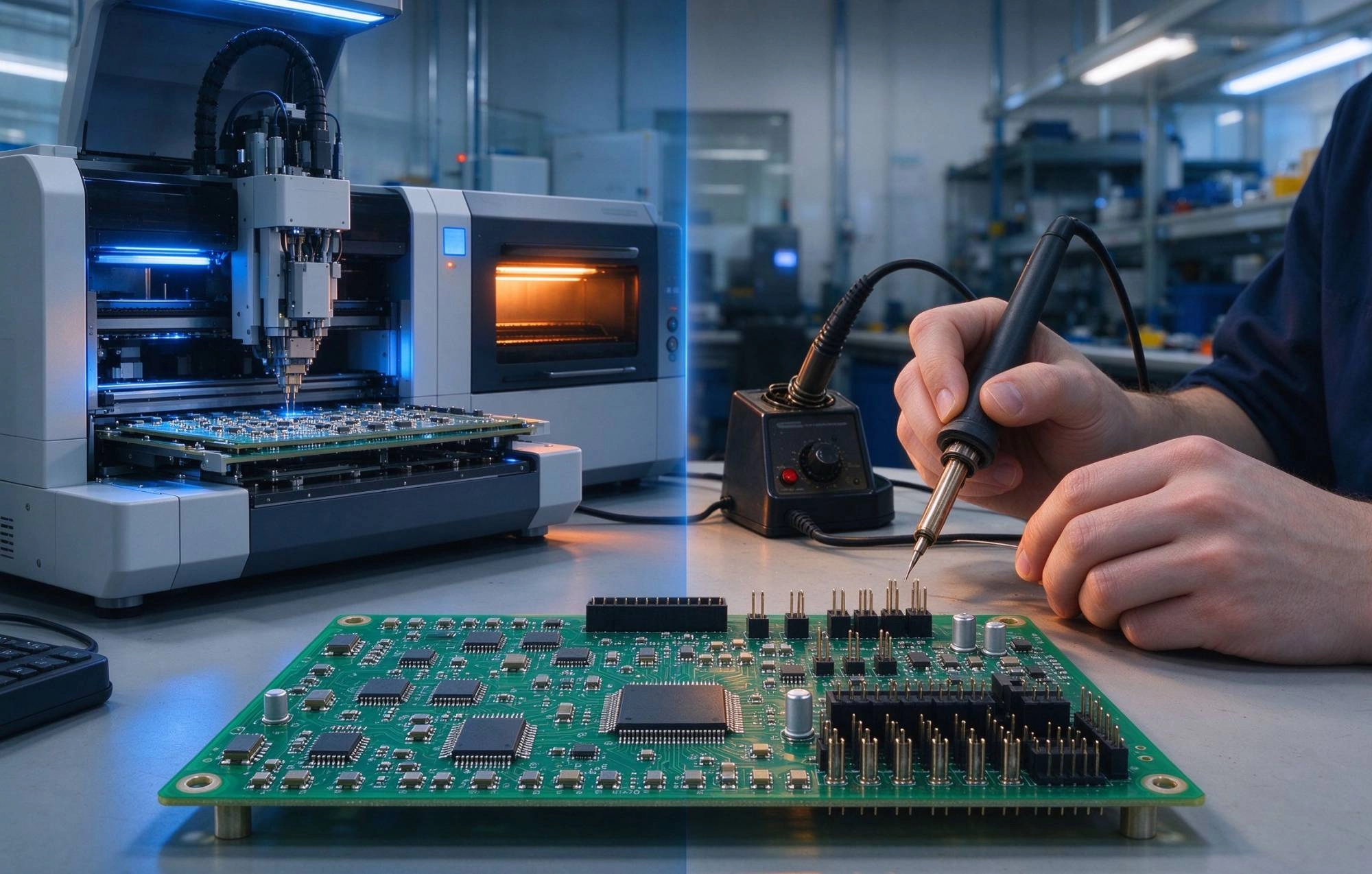
There are four primary assembly methods used by Chinese PCB manufacturers, each suited to different prototype scenarios:
The manufacturer sources all components, fabricates the PCB, and performs the assembly. You provide only the design files (Gerber, Bom, pick-and-place).
You supply some critical or hard-to-source components (e.g., ICs, connectors), and the manufacturer sources the rest (passives, standard parts) and performs assembly.
You supply all components and the bare PCBs (or have the manufacturer fabricate the PCBs separately). The manufacturer only performs the assembly labor.
Technicians manually solder components onto the PCB, typically for very low volumes (1–10 boards) or for boards with large through-hole components that don't justify SMT setup.
| Quantity | Recommended Method | Reason |
|---|---|---|
| 1–5 boards | Manual assembly or turnkey | Setup costs dominate; manual is cheapest, turnkey is most convenient |
| 5–50 boards | Turnkey or partial turnkey | SMT setup cost amortized; manufacturer sourcing is efficient |
| 50–500 boards | Turnkey or partial turnkey | Volume justifies full SMT line; consider consignment if you have bulk parts |
| 500+ boards | Turnkey or consignment | Approaching production volumes; negotiate pricing and consider dedicated fixtures |
China's component market (Huaqiangbei in Shenzhen, LCSC, and numerous distributors) offers incredible breadth, but not every part is in stock. Before choosing a method:
Understand the cost breakdown of a typical Chinese Pcb Assembly quote:
Tip: For prototypes under 50 boards, NRE costs dominate. For larger prototypes, component and labor costs become more significant. Request itemized quotes from 2–3 assemblers to compare.
Chinese PCB assemblers are known for speed. Typical lead times:
If you need expedited service (24–72 hours), expect a 50–100% premium. Plan ahead for Chinese public holidays (Chinese New Year, Golden Week in October, etc.), which can shut down factories for 1–2 weeks.
Not all Chinese assemblers are equal. Match the assembler's capabilities to your needs:
A reputable assembler will provide a free Dfm review of your Gerber Files and BOM before quoting. This report should flag:
The quality of the Dfm Review is a strong indicator of the assembler's engineering competence.
If your project is high-value or high-complexity, ask the assembler for photos of similar boards they have assembled, or request a small test order (5–10 boards) before committing to a larger prototype run.
Ensure the assembler has English-speaking engineering support and a clear escalation path. Many top-tier Chinese assemblers (e.g., JLCPCB, PCBWay, Seeed Studio, NextPCB, KingSong) have dedicated English support teams and online quoting platforms.
Ask upfront:
Assuming all parts are in stock is the #1 cause of prototype delays. Always verify availability before finalizing your order.
A messy BOM leads to quoting errors and assembly mistakes. Your BOM should include:
Use consistent part numbers and avoid generic descriptions like "10k resistor" without a package size.
For prototypes with multiple boards per panel, ensure the assembler can handle your panelization requirements (V-scoring, Tab Routing, Fiducial Marks, tooling holes). Poor panelization can lead to assembly defects or difficulties in Depaneling.
Don't assume assembled boards will work perfectly. Budget time and cost for:
Factor in international shipping time (3–7 days via DHL/FedEx for express, 2–4 weeks for sea freight) and potential customs duties. Some assemblers offer DDP (Delivered Duty Paid) shipping options.
| Method | Best Quantity | Cost Efficiency | Convenience | Control | Lead Time |
|---|---|---|---|---|---|
| Turnkey | 5–500 | ★★★★☆ | ★★★★★ | ★★☆☆☆ | 5–10 days |
| Partial Turnkey | 5–200 | ★★★★☆ | ★★★☆☆ | ★★★☆☆ | 3–7 days |
| Consignment | 10–500+ | ★★★☆☆ | ★★☆☆☆ | ★★★★★ | 3–5 days (after parts arrive) |
| Manual Assembly | 1–10 | ★★★★☆ | ★★★★☆ | ★★★☆☆ | 1–3 days |
Choosing the best Pcb Assembly method for your prototype in China depends on a balance of quantity, component availability, board complexity, budget, turnaround time, and quality requirements. For most prototype projects, Turnkey Assembly offers the best combination of convenience and cost-effectiveness, especially when working with established Chinese assemblers who have robust supply chains. If you need tighter control over critical components, partial turnkey is a flexible middle ground. Reserve consignment for cases where you already have parts in hand or require full traceability, and use manual assembly only for very small quantities or simple boards.
Regardless of the method you choose, invest time in preparing a clean BOM, requesting a thorough Dfm Review, and communicating clearly with your assembly partner. A well-chosen assembly method and a reliable manufacturing partner can turn your prototype from a design file into a working board in as little as a week, accelerating your path to product validation and market launch.
Mixed Assembly Explained: Combining SMT and THT on One PCB in ChinaSeptember/01/2026
Which Technology is Right for Your Project?May/29/2026
Cost Comparison: SMT vs THT PCB Assembly Services in ChinaJuly/07/2026
SMT vs THT PCB Assembly in China: Which Technology is Right for Your Project?June/08/2026
Automation Capabilities: Why SMT Assembly Wins Over THT for Mass Production in ChinaSeptember/10/2026
Design Rules Breakdown: Layout Differences for SMT vs THT Assembly in ChinaSeptember/21/2026
The Pros and Cons of SMT and THT in China's Electronics Manufacturing LandscapeJune/25/2026
The Evolution of Electronics in China: From THT to High-Density SMT PCB AssemblyAugust/06/2026