Open Nav

The deadline is tight. Your boss needs working hardware for the demo next month. The investor meeting is in three weeks. The trade show opens in ten days. So you rush — you compress the design review, skip the Dfm check, submit incomplete files, and push the assembler for the fastest possible turnaround. And then the boards arrive with tombstoned components, solder bridges, wrong parts, and dead circuits. You spend more time debugging and reworking than you saved by rushing in the first place.
Rushing SMT PCB Assembly to China is not inherently wrong — Chinese assemblers are well-equipped for fast turns and many do excellent work on tight schedules. The problem is that rushing amplifies the consequences of every shortcut, every incomplete specification, and every unverified assumption. What would be a minor inconvenience on a leisurely timeline becomes a project-killing crisis when there is no buffer for error correction.
This article catalogs the most common pitfalls engineers fall into when they rush Smt Assembly orders to China, explains why each one is so damaging under time pressure, and provides specific countermeasures that protect your build without significantly slowing it down.
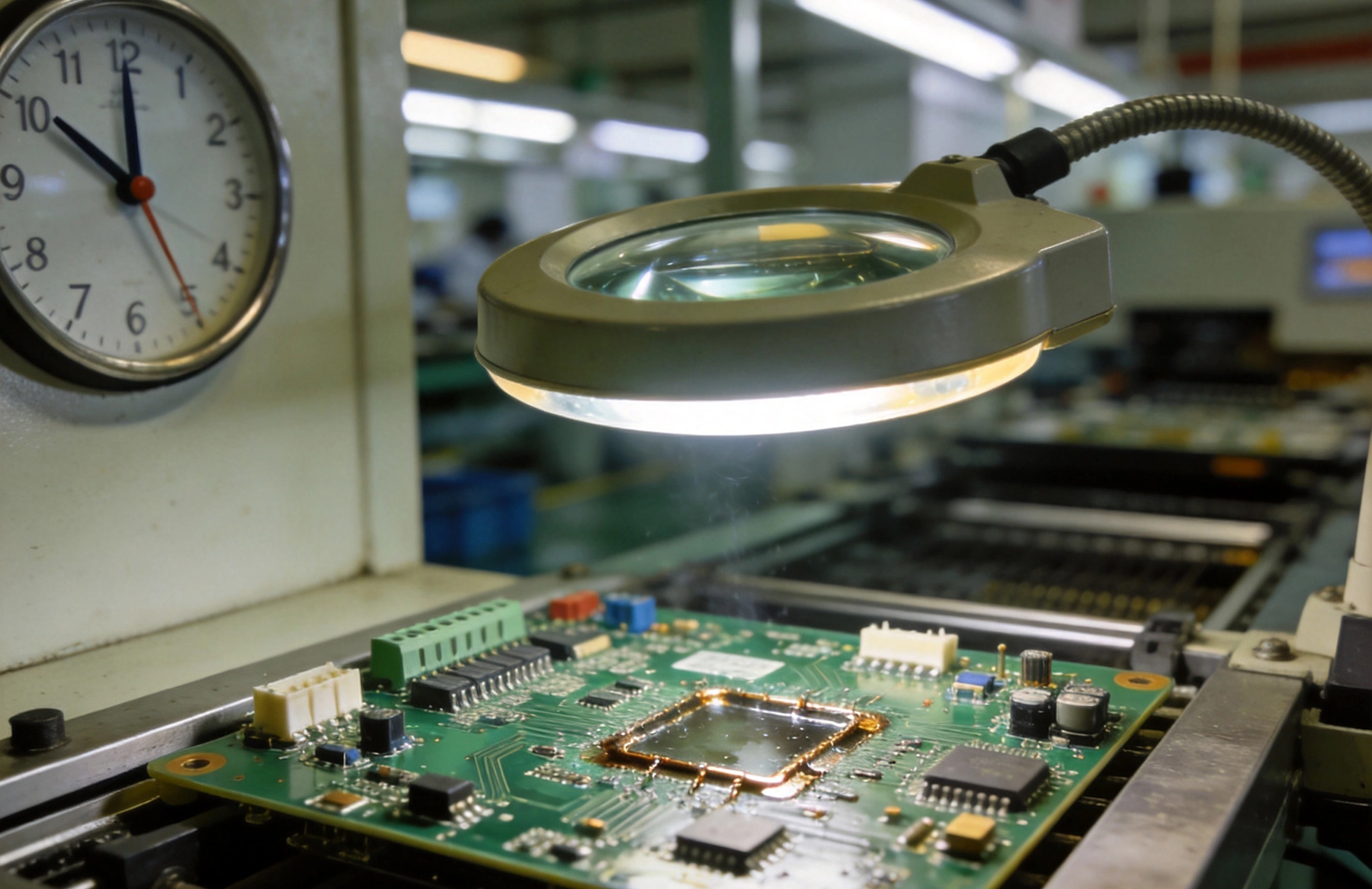
Under time pressure, the first thing that gets cut is file verification. Gerber Files are exported quickly, BOMs are thrown together from schematic data without manual review, and the package is sent off before anyone checks whether all the files are consistent.
Run a file consistency check before submission. Most CAD tools include a design rule check (DRC) and export verification function. Use it. Specifically verify: all required Gerber layers are present, all use the same format and units, the BOM reference designators match the schematic and layout, and the pick-and-place file is generated and included. This takes 30 minutes and prevents days of delay.
The assembler's Dfm review catches design issues that cause manufacturing failures — land patterns that are too small for reliable soldering, component spacing that is too tight for the placement machine, thermal via arrays that cannot be filled in the available time. When you rush, you ask the assembler to skip DFM and go straight to manufacturing. Some will agree — and then you own the consequences.
Never skip Dfm Review. A professional Dfm Review takes 1-2 days and has a very high return on investment — it catches issues that would cause days to weeks of delay if discovered during manufacturing. If your timeline is truly urgent, ask the assembler to run DFM in parallel with Component Procurement. The 1-2 day DFM delay is almost always less than the delay caused by discovering a design error during assembly.
On a normal timeline, the assembler checks every BOM line item for stock and lead time, flags unavailable parts, and proposes alternatives. When you rush, this check is compressed or skipped, and long-lead components are not discovered until procurement begins — by which point it is too late to find alternatives within the schedule.
Do your own BOM availability check before sending the order. Major distributors (Digi-Key, Mouser, Lcsc, etc.) allow real-time stock and lead time queries. Spend two hours checking every line item and flag anything with lead time beyond your schedule. If you find long-lead parts, start sourcing them immediately — even before the design is fully finalized. Identifying availability problems early is the single most impactful thing you can do to protect a rush timeline.
When a BOM component is unavailable on a rush timeline, the assembler may propose an alternative part to keep the build moving. Under time pressure, you may approve the substitution quickly without thorough evaluation. This is especially dangerous for ICs and active components where "equivalent" parts may have subtle but critical differences.
Define your substitution policy before the build begins. For passive components (resistors, capacitors, inductors), allow substitutions from equivalent manufacturers with the same value, tolerance, and package. For ICs and active components, allow no substitutions without explicit review of the datasheet comparison. Communicate this policy to the assembler in writing. Taking 30 minutes to review a proposed substitution is far less costly than discovering a wrong part after assembly.
SPI — 3D inspection of solder paste deposits after printing — catches 60-70 percent of SMT defects at the earliest and cheapest point in the process. Under time pressure, some assemblers skip SPI to save a few minutes per board. This is a false economy that always costs more in the end.
Without SPI, Solder Paste Printing defects — insufficient paste, excess paste, smearing, and offset deposits — are not detected until after components are placed and reflowed. At that point, the defect manifests as a solder bridge, an open joint, a tombstone, or a misaligned component. Reworking these defects takes 10-100× longer than cleaning the board and reprinting — which is all that would have been needed if the defect had been caught at the paste stage.
Insist on SPI as a non-negotiable step, even on rush builds. SPI adds minutes to the per-board cycle time but prevents hours of rework. If the assembler does not have SPI equipment or proposes to skip it, find a different assembler. SPI is a standard capability at any quality-oriented SMT facility, and its absence is a red flag regardless of timeline.
When you rush, inspection is often the first thing compromised. The implicit assumption is that faster delivery means less inspection — and some assemblers will accommodate this by reducing or eliminating post-assembly inspection. The boards ship faster, but they may not work.
Specify your inspection requirements in the purchase order. At minimum, require: first-article verification (manual check of the first board), Aoi after reflow (100 percent for prototypes), and X-ray Inspection of all BGA/QFN components. These steps add hours, not days, to the build timeline, and they prevent the days of debugging that result from shipping uninspected boards.
One of the most common rush-order pitfalls is requesting a lead time that is physically impossible — asking for 5-day assembly when Component Procurement alone takes 10 days. Some assemblers will accept the order and then miss the deadline, leaving you worse off than if you had set a realistic expectation from the start.
Calculate a realistic minimum lead time before requesting quotes. The formula is simple: lead time = longest component lead time + fabrication time + assembly time + inspection time + shipping time. For a typical prototype with standard components: 5-7 days (components) + 3-5 days (fabrication) + 2-3 days (assembly + inspection) + 3-5 days (shipping) = 13-20 business days. If any component has a long lead time, that becomes the floor. Assemblers who quote significantly less than this either have stock of your specific components or are being optimistic. Ask which one it is.
Rush builds require more communication, not less — there are more decisions to make quickly, more issues to resolve, and more status updates needed. Yet under time pressure, communication often deteriorates: emails go unanswered, questions are deferred, and status checks are skipped because "there is no time."
Designate a single point of contact who is available and empowered to make decisions throughout the build. Provide this person's contact information (email, phone, messaging app) to the assembler and commit to same-day response for any technical questions. Set up a daily status check — even a brief email or message — to maintain visibility. For critical rush builds, consider overlapping work hours with the assembler's time zone to minimize communication latency.
The rush mindset assumes that the boards will work the first time. Experience says otherwise — especially for first-run designs that have never been manufactured before. When the boards arrive with defects (and some will), you need time to diagnose, rework, and retest. If your schedule has zero buffer for this, a few defective boards blow the entire timeline.
When time is critical, the natural instinct is to choose the assembler who quotes the fastest delivery. But the fastest quote is not always the fastest delivery — and it is never the fastest path to working boards if quality is compromised.
Evaluate potential assemblers on two axes: speed and reliability. Ask for on-time delivery statistics and first-pass yield data. A shop that quotes 12 days with 95 percent on-time delivery and 94 percent first-pass yield will get you working boards faster than one that quotes 7 days with 70 percent on-time delivery and 80 percent yield. If you have no prior experience with any of the candidates, ask for references from customers with similar projects and verify those references.
Moisture-sensitive components (BGAs, QFPs, large CSPs) must be stored in controlled-humidity conditions and baked before assembly if their floor life has been exceeded. On rush orders, components may be received from distributors with unknown exposure history, and the baking step takes hours that the schedule cannot spare. Skipping the bake saves time but risks popcorning — explosive delamination of the component during reflow.
Ask the assembler about their MSD handling procedures. Confirm that they check MSL ratings and exposure indicators on incoming components, and that they bake when required. If baking is needed and the schedule is tight, start the bake as early as possible — ideally overlapping with other build preparation steps. Do not allow the assembler to skip baking to save time. The risk is too high, especially for expensive BGA components that cannot be easily replaced.
A build report documents what happened during manufacturing — inspection findings, rework performed, test results, and photos of the finished boards. On rush orders, this documentation is often omitted to save time. But without it, you have no record of what was done, what problems were found, and whether the boards meet quality requirements.
Require a build report as part of the deliverable, even on rush orders. A build report does not add to the manufacturing timeline — it is compiled in parallel with the final inspection and packaging steps. If the assembler cannot or will not provide a build report, that is a warning sign about their documentation practices in general.
Before you submit your next rush Smt Assembly order to China, run through this checklist. Each item takes minutes to verify but prevents days of delay:
Yes — but the definition of "rush" must be realistic. A 2-week turnaround for a standard-complexity board with available components is achievable at many quality Chinese assemblers. A 3-day turnaround for the same board is not, regardless of what a salesperson tells you. The key is understanding the difference between a compressed-but-achievable timeline and an impossible one. Push hard on the achievable timelines, but do not push beyond the physical limits of procurement and processing.
For very urgent builds where you need boards in 3-5 days, a local assembler may be faster because shipping time is eliminated. However, local assemblers may have higher costs and more limited component sourcing. For builds with a 2+ week timeline, the shipping time from China (3-5 days via courier) is usually acceptable, and the cost and capability advantages of Chinese assemblers make them the better choice. Evaluate the total timeline — procurement + assembly + shipping — rather than just the assembly lead time.
Stop, communicate, and decide. Do not let the assembler make unilateral decisions to keep the build moving. A 1-day pause to resolve a problem correctly is far better than shipping defective boards that take a week to debug. Establish this understanding with the assembler before the build begins: they must contact you immediately on any issue, and you commit to responding within hours, not days.
It is risky. A first-time build with a new assembler has the highest probability of problems — communication misunderstandings, unfamiliar file formats, different process defaults, and unexpected quality standards. If you must use a new assembler for a rush build, invest extra time upfront in communication: confirm file format expectations, review their process flow, specify your inspection requirements in detail, and establish the communication protocol. The time spent on this upfront communication pays for itself by preventing misunderstandings during the build.
Rush surcharges at Chinese assemblers typically range from 20-50 percent above standard pricing, depending on how much the timeline is compressed and what expedite measures are required (overtime, air freight for components, priority scheduling). The surcharge covers the real costs of faster processing. Be wary of assemblers who offer rush service at standard pricing — they may be cutting quality steps to absorb the cost, or they may be quoting standard delivery as rush and hoping you do not notice.
Rushing SMT PCB Assembly to China is a reality of modern hardware development — deadlines are real, and compressed timelines are often unavoidable. But rushing does not have to mean gambling with quality. The pitfalls described in this article — incomplete files, skipped DFM, unchecked BOMs, unspecified inspection, unrealistic timelines, poor communication, and zero debug buffer — are all preventable with disciplined preparation and clear communication. The time you invest in avoiding these pitfalls is always less than the time you spend recovering from them. Rush the timeline, not the process. Compress the schedule, not the quality controls. The result: boards that arrive on time and work the first time.
Contact us to discuss your requirements

What to Prepare for a Smooth Quick-turn SMT Assembly Order in ChinaAugust/10/2026
Quick-turn SMT Assembly in China: Accelerating Your Time-to-MarketSeptember/15/2026

Industrial SMT PCB Assembly in China: Meeting Durability and Reliability StandardsJune/11/2026

How Digital Inventory Enables Fast Quick-turn SMT Assembly in Chinese FactoriesOctober/15/2026

How to Get Quick-turn SMT PCB Assembly in Just 24 Hours from ChinaMay/29/2026

Why Shenzhen is the Global Hub for Quick-turn SMT PCB AssemblySeptember/04/2026
The Benefits of Quick-turn SMT Assembly in China for R&D and PrototypingJuly/09/2026
How to Get Quick-turn SMT PCB Assembly in Just 24 Hours from ChinaJune/12/2026